
Cut Red Tape, Liberate Farmers, Restore Nature
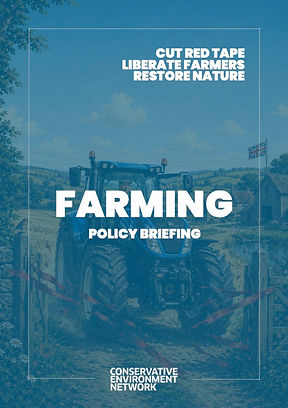
British farming is facing an unprecedented set of challenges. Climate change is making our weather less predictable and biodiversity loss is reducing farmland resilience. This means poorer harvests, decreased yields, and lower incomes for farmers. These challenges have been worsened by historic overregulation which prevents farmers from both restoring nature and securing their livelihoods.
Farming regulations began to be liberalised post-Brexit. This included liberalising precision breeding. While the Labour government has broadly maintained this approach, its renegotiation of the EU trade agreement risks rolling back these reforms.
Liberating farmers from excessive red tape will foster a thriving rural economy and restore nature. Farmers should not be held back from securing their incomes and protecting our natural heritage. This paper provides three solutions to the problem.
Why we need to liberate farmers
Farming in Britain is precarious. Farmers have always seen their incomes fluctuate due to natural factors such as weather and disease. Climate change is now compounding this by increasing weather unpredictability, which makes farming cycles less reliable. In the past few years, Britain has experienced the wettest 18 months since records began in 1836, whilst 2025 saw the driest spring in 132 years.
Excessive regulations are preventing farmers from boosting their resilience. Farmers should be free to take action to protect their incomes and the environment. Whilst the most egregious EU regulations, for example, the three crop rule, have been abolished, regulatory reform must continue. There are more than 3,000 DEFRA regulations. Whilst any one regulation may seem sensible, the totality prevents farmers from having the flexibility to manage their land to better protect their incomes and restore our natural heritage.
We must reform our regulatory system to cut red tape, liberate farmers, and restore nature. We should use our first-mover advantage in precision breeding to enhance our crops and animals; liberalise animal feed regulations to reduce waste and better utilise nature-friendly crops; and expand permitted development rights.
Secure first-mover advantage on precision breeding
Gene editing can make crops more resilient to extreme weather, benefiting both farmers and nature. By withstanding heat and mould, gene-editing can improve our food security and avoid food waste. This technology can also allow English farmers to better weather issues, such as the continued high price of fertiliser caused by the Iran war, by creating crops which need fewer artificial inputs. Finally, by reducing the amount of land needed to produce the same - or a higher - crop yield, farmers are provided with greater flexibility to restore nature on their land.
Laws around gene-editing have been liberalised. In contrast to the strict regulatory approach taken by the EU, the Conservatives passed the Genetic Technology (Precision Breeding) Act 2023, which allows ministers to expedite the commercial development of gene-edited crops in England. Labour has recently passed the necessary secondary legislation to enact these reforms. However, Labour’s plans for a new agri-food deal with the EU could see us forced to follow European rules on gene-editing in return for smoother trade, sowing doubt about gene editing’s future.
Cut red tape to secure England’s first-mover advantage in precision breeding. The government should continue to seek a targeted exemption for precision breeding within the UK-EU SPS Agreement to ensure that this advantage is not lost. Secondary legislation should be used to bring precision-bred plants to the market under the Genetic Technology (Precision Breeding) Act 2023. The government should also expand precision breeding to animals, enabling pastoral farmers to, for example, breed PRRS (Porcine Reproductive and Respiratory Syndrome) resistant pigs.
Liberalise animal feed regulations
Currently, 40% of British arable land is used to produce food for livestock, squeezing out space for other types of farming and nature restoration activities. These crops are supplemented with grass feeding (primarily for cows and sheep), and some food industry byproducts. Excessive red tape is preventing farmers from utilising alternative types of feed. For example, a greater share of the 10.7 million tonnes of food waste produced per annum, could be used as animal feed. Similarly, the use of insects as feed is restricted due to rules introduced in the wake of the BSE outbreak. There is now an opportunity to liberalise animal feed regulations, whilst keeping some restrictions in place (e.g. waste which is a mixture of different animal proteins is not suitable for livestock feed). Before the COVID pandemic, many large retail chains were investing in new procedures to enable a greater use of food waste and insect feed carries a negligible BSE risk as long as they are not fed ruminant-derived materials. Cutting red tape will allow our farmers to save money by expanding the pool of feed, support nature restoration and help to tackle climate change by reducing the amount of land needed to produce traditional, crop-based animal feeds. One example of a successful novel feed is seaweed, the farming of which creates new habitats, produces cheap feeds, and reduces livestock methane emissions.
Progress on liberalising animal feed regulations has stalled. Whilst the government consulted on loosening restrictions on animal proteins in feed in 2025, it has confirmed that it will not amend regulations until the UK-EU SPS Agreement is implemented. Progress on liberalisation should continue, mirroring the EU’s allowance of insect feed for pigs and poultry.
Expand the pool of animal feeds. Overly restrictive animal by-product regulations are preventing greater use of food waste and insects as feed. These regulations should be liberalised to make food production more land-efficient, freeing land for nature restoration. The government should provide greater support for the creation of wildflower meadows to produce hay feeds for livestock. This will boost the hay market and encourage nature restoration by making it easier to plant these meadows.
Expand permitted development rights
Certain nature-friendly works should be exempted from planning permission rules. The government subsidises many types of on-farm nature-friendly infrastructure. For example, by providing grants for slurry stores, which prevents slurry from leaching into habitats. However, despite these projects being deemed sufficiently important to be state-funded, they may still go through the full planning process. Creating new PDRs liberates farmers from unnecessary bureaucracy, making it easier for them to manage their land as they see fit, take nature restorative actions, and diversify their incomes.
The Conservative government created new PDRs to lower costs for farmers. These included digging small on-farm reservoirs and the ability to build, extend or convert agricultural buildings. The Labour government has voiced support for PDRs, but did not commit to further liberalisation within the Farming Roadmap.
Existing PDRs should be expanded and new PDRs created. The maximum size for PDR-applicable on-farm reservoirs should be increased above the current one hectare threshold. PDRs for wildlife ponds and wetlands up to one hectare in area should be created both to make new habitats and protect farmland against flooding and droughts.
To view this publication as a PDF, please click here.
Written by Elliott Malik,
with thanks to Dillon Smith, Kitty Thompson, and Sam Hall.
Disclaimer: The views expressed in this publication do not necessarily reflect the views of each of CEN’s supporters, parliamentarians, ambassadors, advisory council, or board. CEN retained editorial independence throughout the drafting of this work.
.


Comments